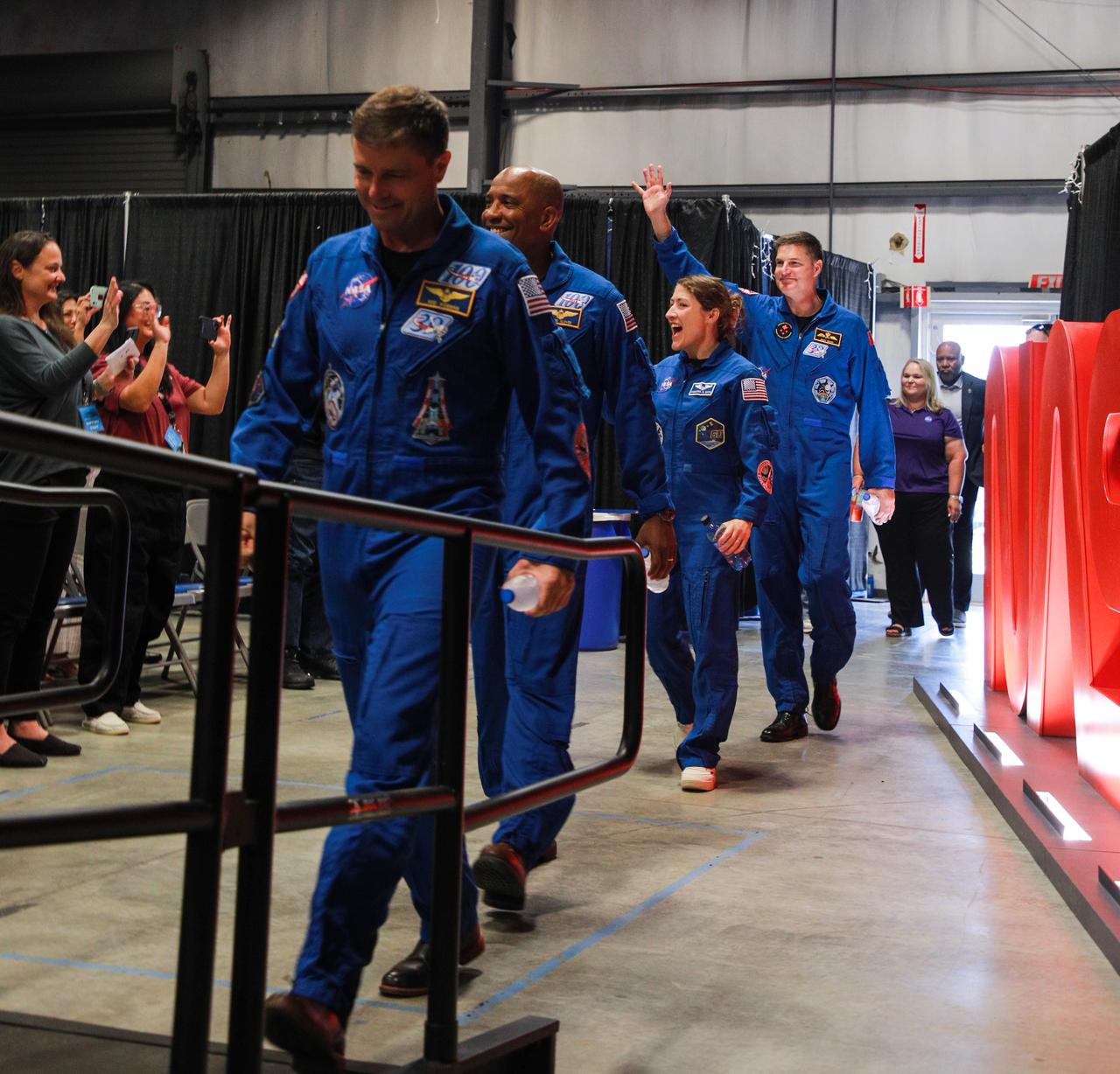
NASA is looking for the explorers who will help write the next chapter of human spaceflight — and the application window is open now, for the first time since 2024.
The window
NASA opened applications on November 7 for its next class of astronaut candidates — the people who, in the agency’s words, will join NASA “as America returns to the Moon, builds the Moon Base, and lays the groundwork for the first crewed missions to Mars.” U.S. citizens have until 11:59 p.m. EST on Thursday, December 3 to submit their completed application materials. NASA expects to make its final selection in late 2027, when the class begins training.
The last call, in 2024, drew more than 8,000 applications; 10 candidates were selected in 2025 and are completing their training now. Since the 1960s, NASA has selected 370 people to train as astronaut candidates, and 32 astronauts are active in the corps today — the ranks this class will join, to study spacewalking, lunar geology, and the operations of high-performance aircraft.
What it takes
The release’s basic requirements:
- United States citizenship.
- A master’s degree in a STEM field — engineering, biological science, physical science, or computer science — from an accredited institution. The requirement can also be met by at least two years of work toward a doctoral program in an appropriate technical field; by a medical degree (Doctor of Medicine, Doctor of Osteopathic Medicine, Physician Assistant, Doctor of Nursing Practice, Family Nurse Practitioner, or related); or by a nationally recognized Test Pilot School program, completed by July 2027, alongside a bachelor’s degree in a STEM field.
- At least three years of related professional experience after completing the qualifying degree. Pilots may meet it through flight experience: 750 hours of pilot-in-command time in high-performance jet aircraft; 1,500 total flight hours including 750 as pilot in command in other fixed-wing aircraft; or 1,000 total hours including 300 as pilot in command in rotary-wing aircraft. For physicians, residency training counts and must be completed by July 2027.
- NASA’s long-duration astronaut flight physical — and demonstrated leadership, teamwork, and communication skills.
In NASA’s own words
Administrator Jared Isaacman, on who this call is for:
Deputy Administrator Matt Anderson was shorter: “The window is open. The mission is waiting.”
Why this desk is watching
Mission Control’s countdown runs to Artemis III and the crewed return that follows it. Crews are not conjured at the launch pad; they are selected years ahead, out of a call exactly like this one. A class chosen in late 2027, after roughly two years of candidate training, is the generation from which NASA will draw the astronauts who operate on the lunar surface in the decade of the Moon Base — the missions this journal exists to track, and the missions the Moonwatch returns on the wrists of EVA crews.
That is a frame, not a forecast: the release names no missions for this class, and neither do we. But when a future crew steps onto the surface near the lunar South Pole, there is a fair chance their application went in before December 3, 2026.
Apply, or read the full requirements: NASA’s release and application links are at nasa.gov — applications close December 3 at 11:59 p.m. EST.
Sources: NASA news release, “NASA Seeks Next Generation of Explorers to Join Astronaut Corps” (Nov 7, 2026) — nasa.gov/news-release/nasa-seeks-next-generation-of-explorers-to-join-astronaut-corps · NASA Johnson Space Center, Facebook post (Nov 7, 2026). All requirements, figures, and quotations are NASA’s, verified against the release text.