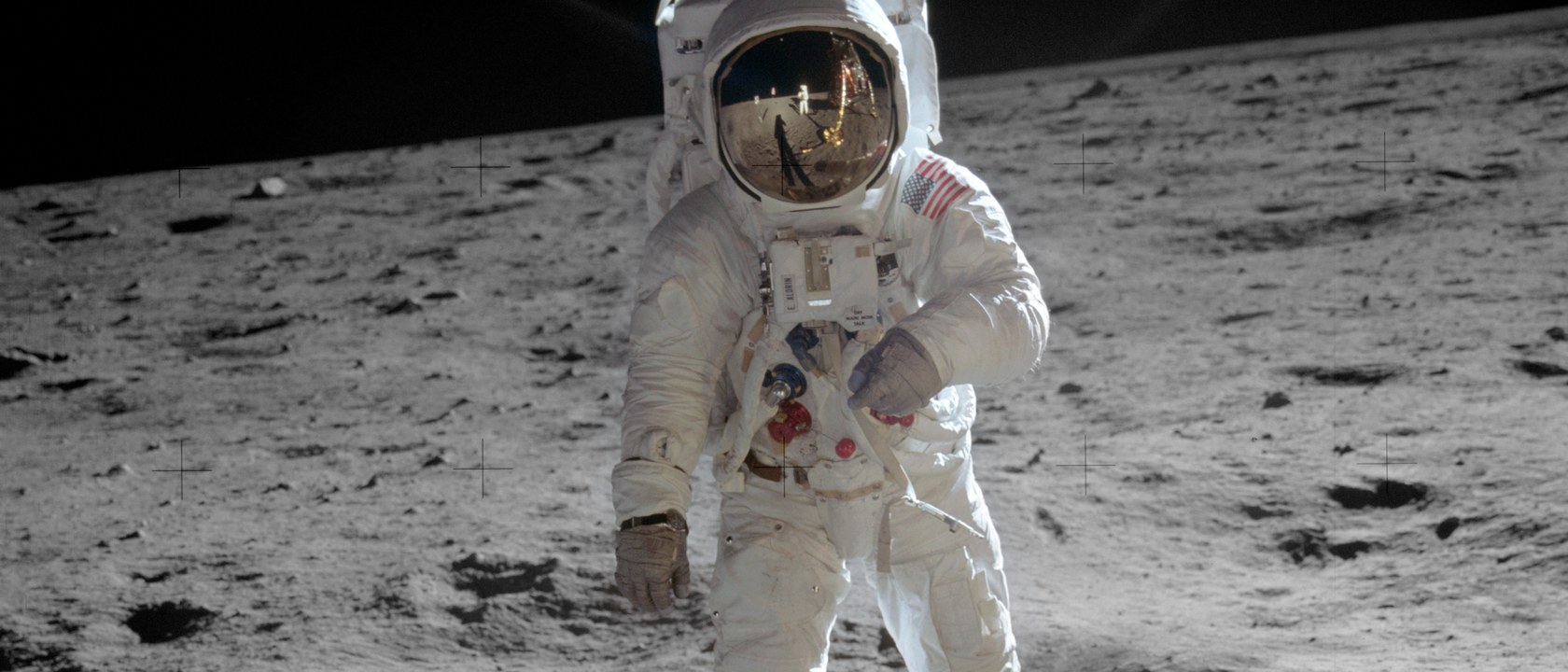
On July 20, 1969, Buzz Aldrin stepped onto the lunar surface with an Omega Speedmaster Professional strapped to his wrist — the first wristwatch ever worn on another world. It survived the vacuum, the dust, and the quarter-million-mile journey home. What it did not survive was the trip to Washington. Somewhere between Houston and the Smithsonian, the most famous watch in history simply vanished.
The watch
The crew of Apollo 11 flew NASA-issued Speedmasters: the calibre-321 generation, the reference most accounts identify as the ST 105.012 — the first of the asymmetric "Professional" case line that replaced the earlier straight lugs. (That identification is conventional rather than certain; it is as far as the evidence comfortably goes, and this publication will not pretend otherwise.) Armstrong wore the same reference. Michael Collins, orbiting above in Columbia, wore an ST 145.012.
Only two of the three watches were destined for the surface. Shortly before the landing, the lunar module's electronic timing system malfunctioned, and Armstrong made a commander's decision: he left his Speedmaster aboard Eagle as a backup timer. Aldrin's watch therefore went down the ladder alone. It is visible in the photographs Armstrong took on the surface — a small, legible instrument on a wrist inside a spacesuit, doing exactly what it had been qualified to do four years earlier.
The disappearance
Aldrin told the story himself, in his 1973 memoir Return to Earth. Preparing for a move, he decided to offer several of his flown artifacts to the Smithsonian Institution — including, in his words, "the Omega watch I had worn on the surface of the moon." NASA hired special packers. The collection was inventoried and shipped to Washington. And when the packages arrived, the watch — along with several medals — was missing.
NASA launched a security investigation. It could not turn up any clues. Note what Aldrin's account does not say: it does not say the watch was stolen, only that it was missing on arrival. Theft is the assumption everyone makes; no thief, method, or location has ever been established. Even the year is soft — sources variously report 1970 or 1971, and "1970–71" is the honest framing. What is certain is the outcome: the first watch worn on the Moon never reached its museum.
The irony
The disappearance had a consequence Aldrin never intended, and it is the human core of the story. The Government Accounting Office, reviewing the affair, ordered all astronauts' flown watches returned to NASA. The flown Speedmasters had been U.S. government property all along — the astronauts kept theirs by tradition, not by title — and one man's attempt at generosity ended the tradition for everyone.
Aldrin called the ruling narrow-minded. He wrote that he felt badly for the other astronauts, "nearly all of whom were grumbling audibly." Consider the ledger: a single missing watch, and in exchange, every flown chronograph in every astronaut's drawer went back to Houston. The bureaucracy did not lose the watch. It simply made sure no one else would ever lose one again.
The claim that failed
Over the decades, reports of the missing Omega surfaced again and again. All were dismissed as false leads — except one that made it to federal court. In 2003, a California man named Stephen Morely sued, claiming the moon watch was his: he said he had bought it for $175 from a college student's classified advertisement in the early 1990s, and that the seller's father had found it on a beach near Santa Barbara in the early 1970s. Morely even offered a theory — that Aldrin had lost the watch on that beach while watching an Apollo launch.
NASA investigated. The agency deposed a former Apollo-era NASA employee and examined the claim in detail. NASA and Aldrin concluded it was not the moon watch, and a federal judge in San Diego dismissed the case in June 2004. Through his attorney, Aldrin said he would love to have the watch back — and that if the Smithsonian wanted to exhibit it, he would lend it to them. The government's position, stated plainly by an unnamed official at the time: if the watch is the one Aldrin wore on his moonwalk, it is the property of the United States government.
That last sentence is worth sitting with. It means the mystery has a legal lock on it: even if the watch surfaced tomorrow in an estate sale or a safe-deposit box, the finder could not simply keep it, sell it, or consign it. The most valuable missing watch in the world is also, in a sense, unsellable.
Where the others rest
The rest of Apollo's flown Speedmasters are accounted for, and nearly all of them can be visited — which is precisely what makes Aldrin's absence so conspicuous:
- Armstrong's Apollo 11 Speedmaster — the one left in the lunar module as a backup timer — was transferred to the Smithsonian's National Air and Space Museum in 1973 and is on display there today. It carries a delightful footnote: when museum director Michael Collins once inventoried "his" watch, its serial number revealed it was actually Armstrong's. The crew's watches had been mixed up after post-mission cleaning, and the Smithsonian corrected the records.
- Collins's Apollo 11 Speedmaster (ST 145.012) was transferred to the museum in 1990, displayed alongside the Columbia command module, and traveled the country in the Smithsonian's "Destination Moon" tour. It now sits in the museum's Destination Moon gallery on the National Mall.
- Gordon Cooper's Gemini V Speedmaster — a pre-Apollo bonus — is on display beside them in the Destination Moon gallery. The Smithsonian's astronaut chronograph collection numbers sixty-three pieces, but most live in storage.
- Pete Conrad's Apollo 12 Speedmaster (105.012 — the third man on the Moon), a Smithsonian-owned piece on loan, has been displayed at the Kennedy Space Center Visitor Complex's Treasures Gallery in an Omega-supported exhibit. Confirm it is still on view before making the trip.
- The Omega Museum in Biel/Bienne, Switzerland, keeps Eugene Cernan's Apollo 17 Speedmaster (ST 105.003) — the last man on the Moon's watch — on display, alongside Ronald Evans's Apollo 17 Speedmaster, the heat-flow-experiment watch Evans kept as a memento and the museum acquired at auction in 2015.
- Also at Bienne: Richard Gordon's Apollo 12 Speedmaster, worn in lunar orbit and on loan from the Smithsonian — plus the gold Apollo XI commemoratives presented to Nixon and Agnew. Loans rotate; confirm before traveling.
And recoveries do happen. Donn Eisele's Apollo 7 Speedmaster was stolen while on loan in Ecuador and vanished for roughly thirty years — until it resurfaced and was returned to the Smithsonian in 2017. These watches have a way of coming home. Just not this one. Not yet.
The open question
As of this writing — more than fifty-five years after the moonwalk — Aldrin's 105.012 remains missing. Coverage of the 2026 Edwin Aldrin Family Trust auction, which offered two dozen of Aldrin's watches, noted pointedly that the missing lunar-worn Speedmaster was not among them: it "remains lost in transit to the Smithsonian National Air and Space Museum."
Smithsonian curator Jennifer Levasseur, who oversees the museum's astronaut chronograph collection, has said she has heard "a lot of possible stories" about where the watch might be — and that the legend has created "a sort of an aura around the astronaut watches." She is right about the aura. The Speedmaster's reputation was built on instruments that endured: the watch that survived NASA's eleven tortures, the watch that timed Apollo 13's burn, the watches still ticking in museum cases. This one's reputation is built on an absence — on a velvet cushion with nothing on it, on an inventory sheet with a line that will not balance.
Somewhere, perhaps, it still ticks. Or it sits silent in a drawer, its owner unaware that the modest chronograph in the box is the first watch ever worn on the Moon — government property, unsellable, unmistakable, and missing. The collector in me hopes it surfaces in my lifetime. The historian in me hopes whoever holds it knows what they have. And the romantic in me hopes it is somewhere with a window, where on a clear night it can see the place it once went.
Sources
- collectSPACE — "Buzz Aldrin's missing Apollo 11 Omega Speedmaster" (Aldrin memoir account, Morely lawsuit, NASA investigation): collectspace.com
- Smithsonian Air & Space — "Space Timekeepers" (curator Jennifer Levasseur on the missing watch and the astronaut chronograph collection): smithsonianmag.com
- Space.com — Donn Eisele's Apollo 7 Speedmaster recovered after ~30 years: space.com
- National Air and Space Museum — Armstrong's Apollo 11 chronograph (collection record): airandspace.si.edu
- National Air and Space Museum — Collins's Apollo 11 chronograph (collection record): airandspace.si.edu
- National Air and Space Museum — "Space Time Technology" (the astronaut chronograph collection): airandspace.si.edu
- Hodinkee — "Found: Neil Armstrong's Speedmaster" (the Collins/Armstrong serial-number mix-up): hodinkee.com
- Hodinkee — Pete Conrad's Speedmaster on display at Kennedy Space Center: hodinkee.com
- Omega — 50th anniversary of Apollo 17 (Cernan's Speedmaster on display at the Omega Museum): omegawatches.com
- Space.com — Ronald Evans's Apollo 17 Speedmaster sells at Christie's, acquired by the Omega Museum: space.com
- Aldrin, Buzz — Return to Earth (1973), via collectSPACE's reporting of the memoir's account.