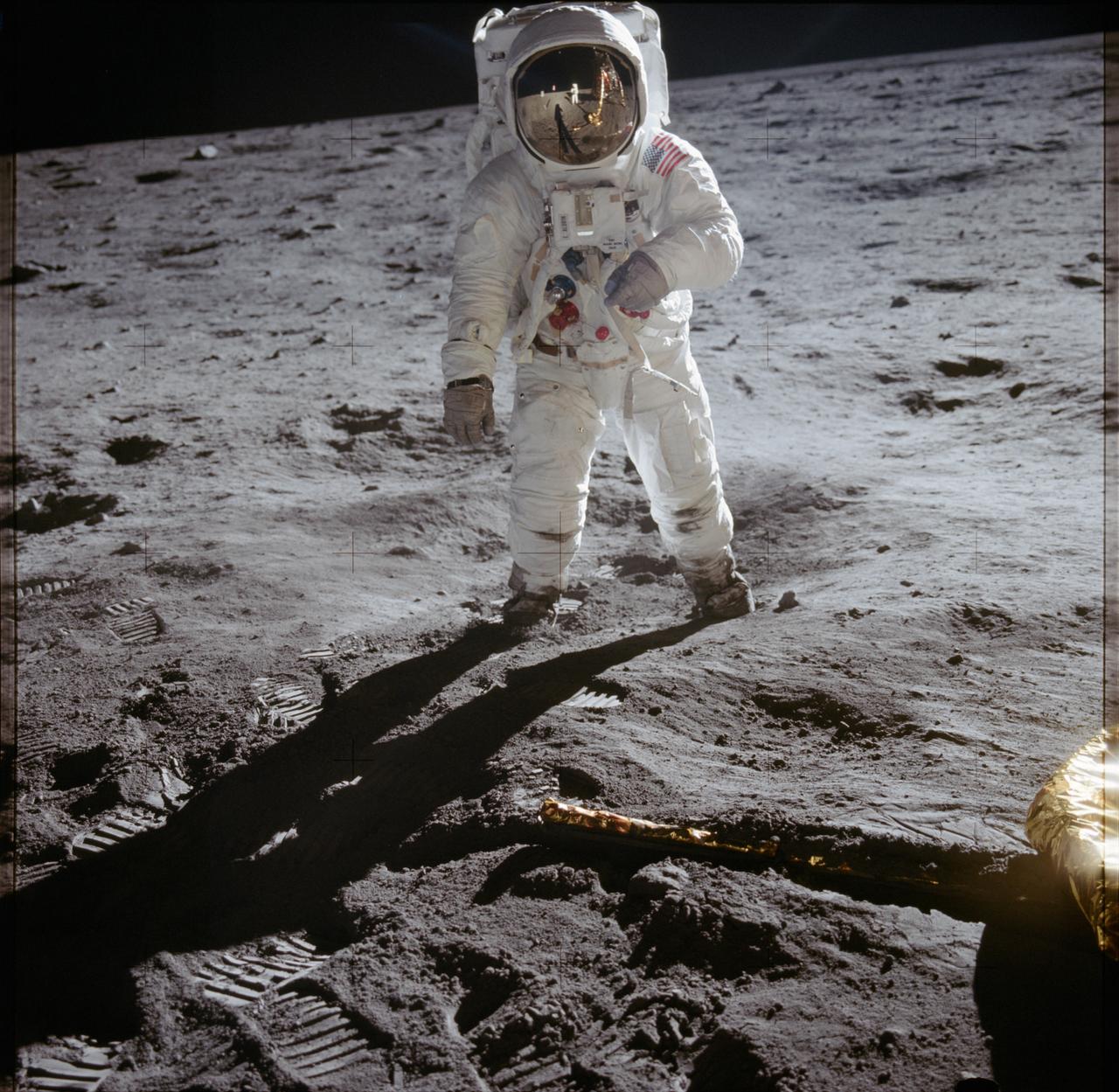
Apollo is where the Speedmaster stopped being equipment and became legend — not through advertising, but through three facts no marketing department could invent: a watch on the Moon, a watch that timed a rescue, and a watch that vanished.
Apollo 11: the first watch on the Moon
July 20, 1969. Buzz Aldrin stepped onto the lunar surface wearing his NASA-issued ST 105.012 — strapped, in his own words, “onto my right wrist around the outside of my bulky spacesuit.” It is the first wristwatch ever worn on the Moon, visible in Neil Armstrong’s AS11-40-5903 photograph. The 105.012 reference page covers the watch itself; the moment belongs here.
Armstrong’s own 105.012 stayed in the Lunar Module as a backup timer after the LM’s mission timer malfunctioned — the longstanding NASA account, repeated across Smithsonian and agency retellings. A caveat the record demands: a 2015 inventory review found the Smithsonian’s watches logged as Collins’ and Armstrong’s had been mixed up during post-flight cleaning and return, so “Armstrong’s watch in the Smithsonian” carries an asterisk the museum itself acknowledges. Armstrong’s chronograph was transferred to the museum in 1973.
And then the third fact: Aldrin’s Moon-walked 105.012 never arrived at the Smithsonian. Lost in transit around 1971, it has never been recovered — the most famous missing watch in horology. We tell the full story, and keep the file open, in The Missing Moonwatch. (Stolen or lost? The museum confirms only that it never arrived; “stolen” is inference, and we don’t state it.)
Apollo 13: fourteen seconds
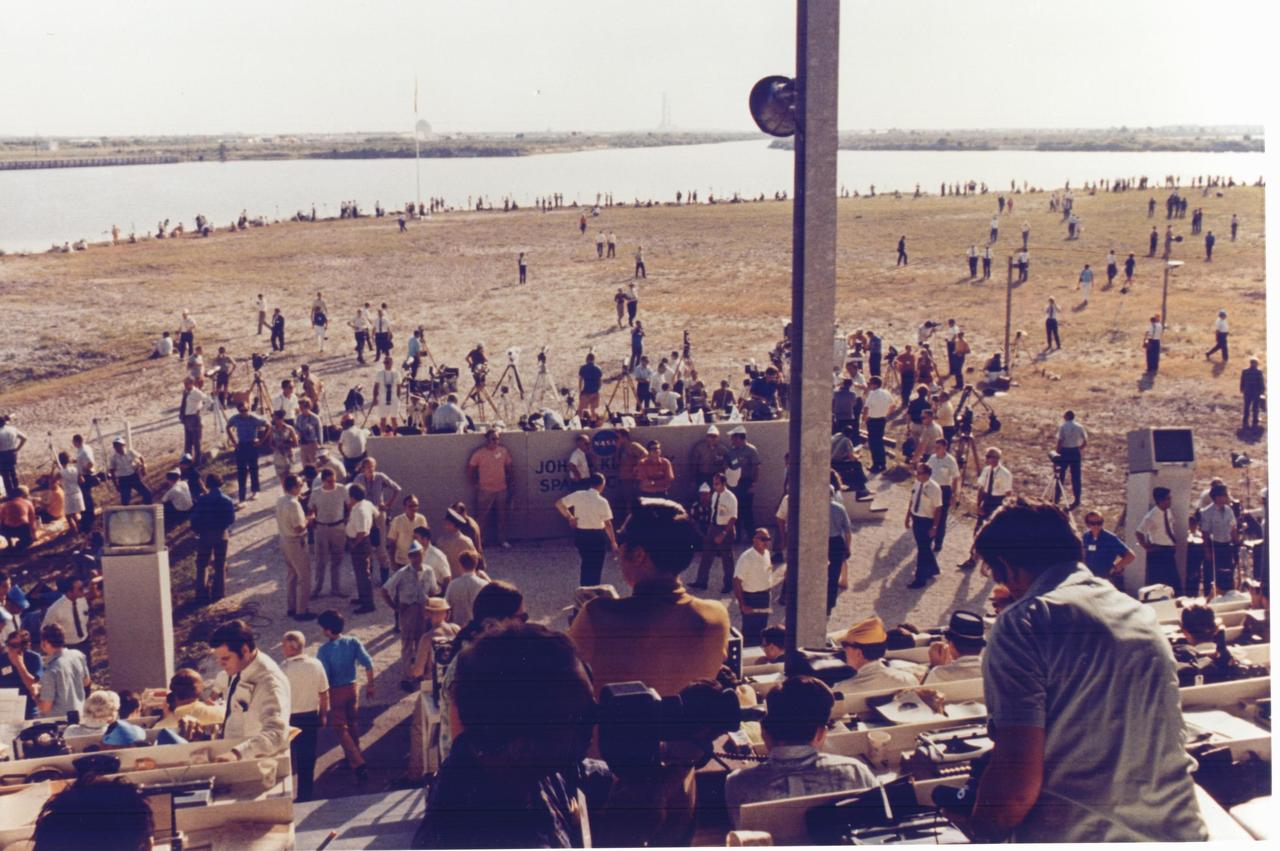
April 1970. With the service module crippled and the digital timers powered down to conserve power, Apollo 13 needed a manual mid-course correction burn — and Jack Swigert timed it on his NASA-issued Speedmaster chronograph: about fourteen seconds, while Jim Lovell held the Earth’s horizon in the window and Fred Haise held pitch. Lovell later put it plainly: “We used the OMEGA watch that Jack had on his wrist.”
The honest framing: fourteen seconds was the commanded cutoff; later NASA histories measure the actual firing at 14.8 to 15.4 seconds depending on boundaries. What isn’t in dispute is that a mechanical chronograph did the job the computers couldn’t. In October 1970 — per contemporary reporting — NASA astronauts presented Omega with the Silver Snoopy Award for the Speedmaster’s role in the rescue, the institutional honor that made the “Snoopy” Speedmasters collectible decades later.
The other Moon landings
The Speedmaster flew on every landing, but the exact sub-references per mission rest on collector-forum attributions — NASA’s serial records aren’t public — so we state only what the record supports: 105.012s and later 145.012s across Apollo 12 through 16, with 145.022s reaching the program by Apollo 17.
Two stories stand on firmer ground. On Apollo 15, Dave Scott’s Omega lost its hesalite crystal during EVA-2; for EVA-3 he wore his personal Bulova chronograph — the only American-made watch ever worn on the Moon, and a landmark in its own right: it sold at RR Auction in October 2015 for $1,625,000 including buyer’s premium (hammer $1.3 million). (Full sale details — including a discrepancy in the house’s later reporting — live on our Notable Sales page.)
On Apollo 17, command module pilot Ron Evans flew a Speedmaster mounted for the Heat Flow and Convection experiment — hand-engraved by Evans himself: “Ron Evans / Flown in CSM / to the moon / Apollo 17 / 6-19 Dec 72 Heat Flow Exp.” A working instrument, marked by the man who worked it.
The gold tributes
November 1969, Houston. At a gala at the Hotel Warwick, Omega presented the Apollo crews with 18-karat gold Speedmasters — ref. BA145.022, the “Tribute to Astronauts” — engraved “To mark man’s conquest of space with time, through time, on time.” They were gifts, not flight kit, and they’ve become auction landmarks in their own right: Neil Armstrong’s example sold at RR Auction in April 2025 for $2,125,000, the house’s official figure. The Notable Sales page carries the full record.
Speedmaster Gonzales™ is an independent horology publication. It is not affiliated with or endorsed by NASA, the Smithsonian Institution, Omega SA, or any astronaut or estate named here. Watch identifications are editorial commentary on the public historical record.
Sources: NASM object record: Armstrong’s Apollo 11 chronograph · Smithsonian Air & Space Magazine, “The Watches That Went to the Moon” (2015) · NASA SMA: Apollo 13 mission overview · collectSPACE: the Silver Snoopy presentation (Oct 1970) · The Register: Scott’s Bulova at RR Auction (Oct 2015) · RR Auction: Armstrong’s gold tribute at auction (Apr 2025)