Which Speedmaster flew each era
Every era of human spaceflight has had a Speedmaster on the wrist. Not the same watch — the lineage evolved with the missions. This is the line, era by era.
-
1961 – 1975 · Apollo era
The Moonwatch
Speedmaster Professional — refs 105.003, 105.012, 145.012

Apollo 11 climbs away from LC-39A — two Speedmasters aboard, one destined for the lunar surface · Photo: NASA, public domain On March 1, 1965, NASA declared the Speedmaster “Flight Qualified for All Manned Space Missions” — the only wristwatch ever qualified for extravehicular activity. The mechanical chronograph that followed went everywhere the program did: Ed White’s 105.003 on the first American spacewalk, Buzz Aldrin’s on the lunar surface at Apollo 11, Jack Swigert’s timing the life-saving burn on Apollo 13.
- Flight qualified March 1, 1965 — survived all eleven NASA environmental tests without modification.
- Apollo 11, July 1969 — two Speedmasters flew; Aldrin’s was the first wristwatch worn on the Moon.
- Apollo 13, April 1970 — earned Omega NASA’s Silver Snoopy Award for flight safety.
-
1981 – 2011 · Shuttle era
The professional continues
Speedmaster Professional, then the X-33 from 1998

Discovery heads uphill — the Shuttle era carried the Speedmaster on 135 missions · Photo: NASA, public domain The Moonwatch kept flying on the Shuttle, and then the family grew a second branch. The Speedmaster X-33 — a titanium ana-digi mission timer developed with direct input from astronauts on the functions they actually needed: mission elapsed time, alarms, countdown — was flight-qualified by NASA in 1998 and joined the issue kit.
- X-33 introduced 1998 — co-developed with astronauts, flight-qualified by NASA the same year.
- Still a Speedmaster — same name, same lineage, a different instrument for a different kind of flying.
-
1998 – present · ISS era
Standard issue
Speedmaster X-33 — the ana-digi mission timer

The view from the Station, where the X-33 became standard issue · Photo: NASA, public domain Aboard the International Space Station, the X-33 became the working watch — the one crews reach for when the mission needs mission-elapsed time, multiple alarms, and a chronograph that reads at a glance in any light. The mechanical Moonwatch stayed in the family as the heritage piece; the X-33 did the daily work.
- Standard issue — a 2013 U.S. government document called the X-33 “the watch of choice for U.S. astronauts.”
-
2022 – present · Artemis era
Back to the Moon
Speedmaster X-33 Gen 2 — ref. 318.92.42.79.01.001
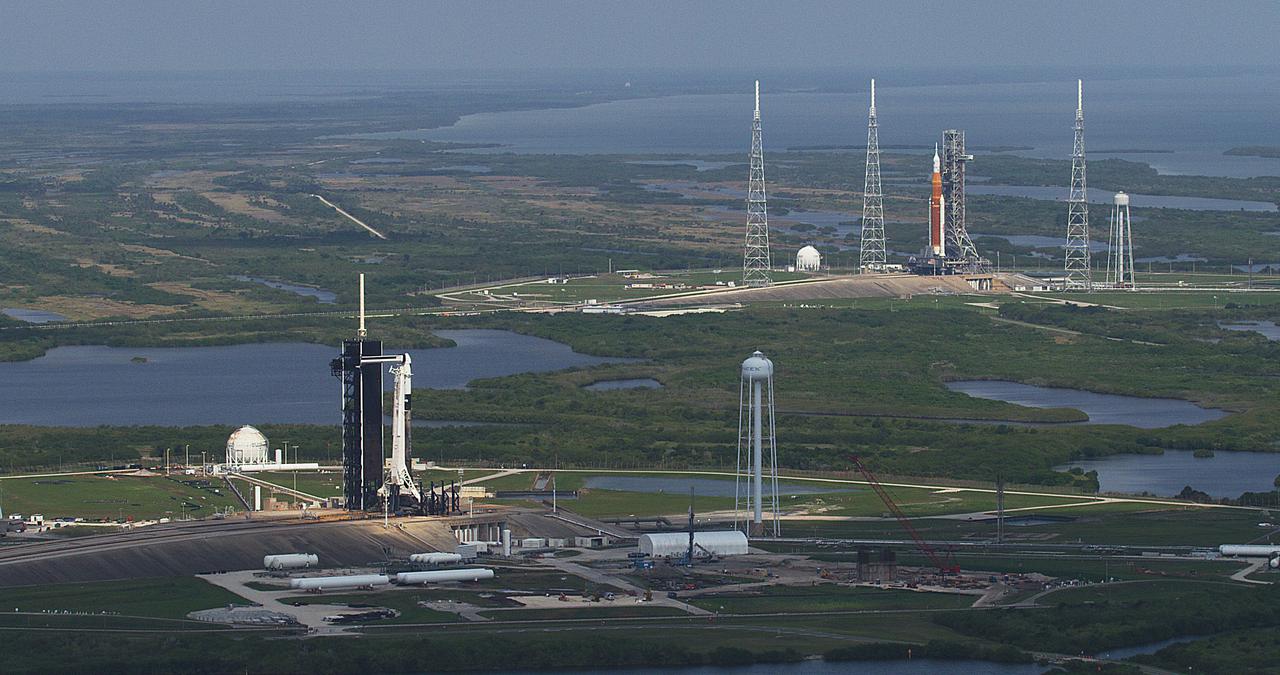
Artemis I on the pad — the uncrewed proving flight before the crew returned · Photo: NASA, public domain On April 1, 2026, Artemis II — Commander Reid Wiseman, pilot Victor Glover, mission specialists Christina Koch and Jeremy Hansen — became the first crew toward the Moon since 1972. All four astronauts were photographed wearing the second-generation Speedmaster X-33 strapped over their suit sleeves at launch: the visible, operational mission watch of the flight.
The crew also carried personal watches, per a NASA-sourced rundown published by Fratello: Glover brought a personal X-33 on bracelet and a new Speedmaster Professional Moonwatch (calibre 3861); Koch brought her father’s Speedmaster Moonwatch; Hansen a Speedmaster Dark Side of the Moon; Wiseman an additional Speedmaster. The mechanical Moonwatch rode along — but the mission timer, the watch doing the work, was the X-33.
- Artemis II — April 1, 2026, 10-day crewed free-return lunar flyby from LC-39B.
- Artemis III — crewed lunar landing slated 2028, with a low-Earth-orbit test mission preceding in 2027.
Sources
- Fratello — The Watches Worn on the NASA Artemis II Mission: fratellowatches.com/the-watches-worn-on-the-nasa-artemis-ii-mission
- Gear Patrol — The Omega Speedmasters Currently on Their Way to the Moon: gearpatrol.com/watches/omega-speedmaster-artemis-ii
- Speedmaster Gonzales™ — A line drawn to the Moon, the full qualification-to-Apollo account with bibliography.